culture
Yu-Su-Ru: The Thousand-Year-Old Japanese Ritual TikTok Keeps Reinventing
Rice water for skin isn't a TikTok invention. Here's the honest history: what can be documented about Heian-era rice rinse water, what is tradition as commonly retold, and how a sake-brewery story became SK-II's Pitera.
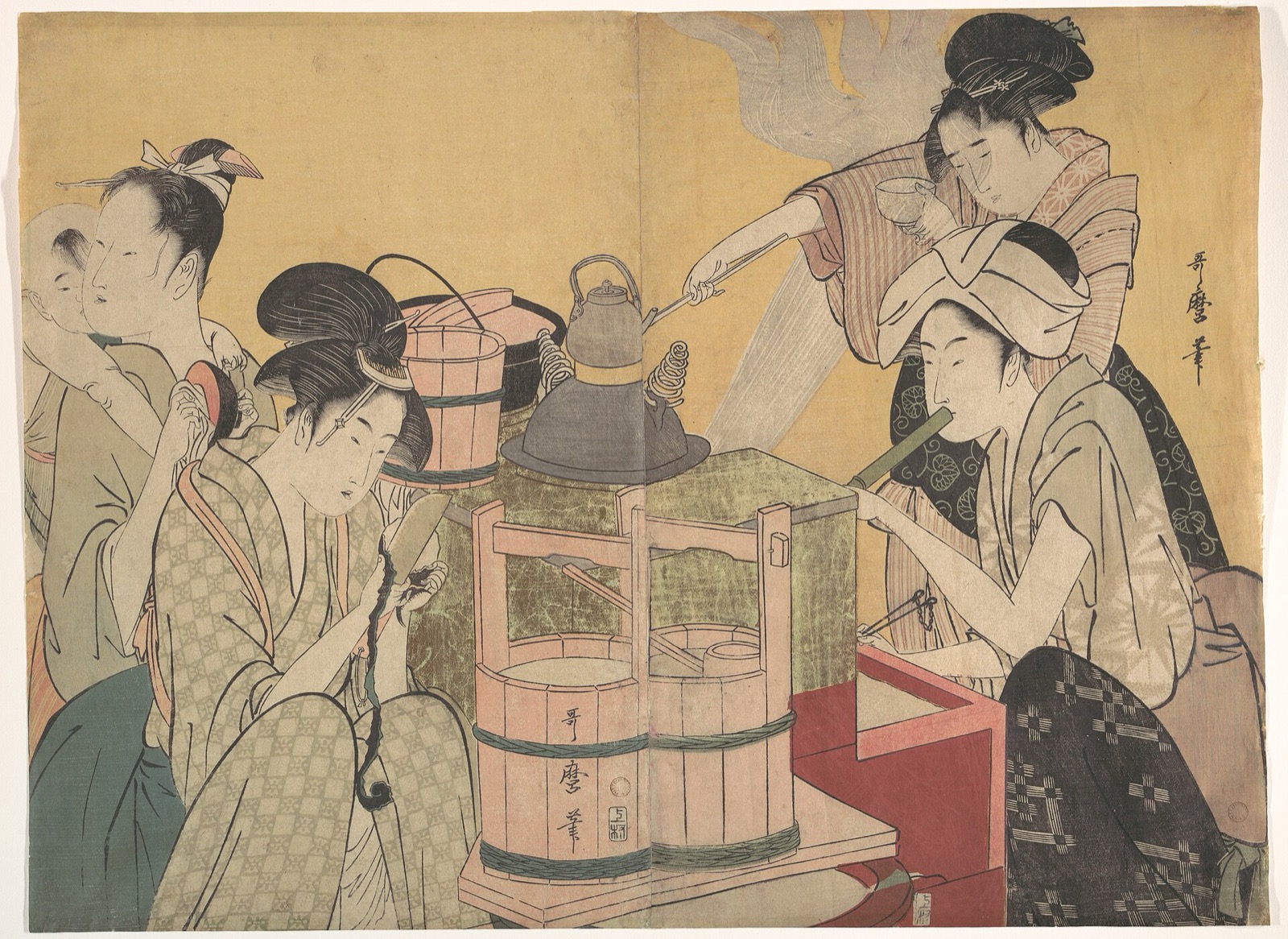
Every few years a skincare idea goes viral and gets treated as new. Rice-water ice cubes are the current one. The rinse-water part is old. How old, and what people did with it, is less certain than most articles, including an earlier version of this one, make out.
We went back to check what could be verified. Quite a lot of what we had written could not. This is the corrected version.
Home-remedy note: this article is about history and culture, not medical advice. A long tradition shows that people valued a practice. It doesn’t show that the practice does what is claimed for it.
What can be documented: Heian hair
The Heian period is the era of Japanese court culture conventionally dated 794 to 1185. The best source we could verify for rice water in that court is a 2010 abstract by Japanese cosmetic scientists, who had researched the history of Japanese women’s hair care before running their own tests. They wrote that “the court ladies of the Heian Period, whose beautiful long hair, called suberakashi, reached to the floor, were said to have combed their hair each day using Yu‐Su‐Ru (rinse water obtained from the washing of rice)” [Inamasu et al. 2010].
Three things about that sentence.
It’s about hair. The verified tradition is a hair-combing practice. We found nothing we could check that describes Heian women using it on their faces.
“Were said to have.” The scientists are reporting a tradition. They aren’t quoting a diary or a court record, and neither can we. We looked for a primary source and didn’t find one; it is listed among the things we could not verify.
The name. Yu-su-ru is the word they use for the rinse water itself. An earlier version of this page translated it and gave it in Japanese script. We couldn’t verify either, so both are gone.
The same abstract includes a detail the romantic versions leave out. When the researchers treated hair with the rinse water alone, “flaking was observed on the hair surface”, and they went on to work with extracts instead. The traditional method, tried in a modern lab, left residue.
What we used to say and have removed
In the interest of showing our working, these claims were on this page until November 2026 and have been taken down because we could not find a source we could fetch and quote:
- That rice water was a documented part of geisha skincare.
- That fermented, aged rice water was preferred “consistently across Japanese, Korean and Chinese traditions”.
- That traditional use was “periodic rather than daily”. The one verified source says daily, for hair.
- That Heian women were unknowingly applying a specific list of active compounds. No one has measured what is in rinse water from polished rice.
- A count of yeast strains screened in the SK-II story, and figures for the brand’s revenue and price.
- A romanised Korean term that was simply wrong.
Any of these may be true. If you can point us to a source, we’d like to see it.
The sake brewery story
The other pillar of rice-water lore is modern. As the brand’s history is usually told, “it was observed that elderly workers at a sake brewery had smooth, clear and young-looking hands”, and then: “A yeast extract that the company calls Pitera was eventually isolated for cosmetic use and the brand was launched in the early 1980s.” [Wikipedia, SK-II]
That is an origin story, told by a company about its own product and repeated in an encyclopedia. It may well be true. It is also about yeast. The ingredient, Galactomyces ferment filtrate, is produced by one cultured organism, and its research consists of cell-culture work [Takei et al. 2015] and a year-long study of branded products carried out by the company’s staff [Miyamoto et al. 2023].
It’s common to draw a line from the Heian court through to this essence and on to a jar of rice water fermenting on your counter. We used to draw it too. The pieces don’t join: a hair rinse reported from the tenth century, a yeast filtrate commercialised in the twentieth, and a kitchen ferment that has not been studied at all.
Korea, and the wider region
Korean has an everyday word for the water rice is rinsed in, 쌀뜨물 (ssal-tteu-mul), a kitchen term. Modern Korean brands sell rice toners and rice-ferment products, and our comparison of ferment essences looks at several by their published ingredient lists.
What we can’t do is give you a verified history of rice water as Korean or Chinese skincare. A dermatology review says only that “Rice has been used for cosmetic purposes for centuries” [Zamil et al. 2022], and a review of rice for hair describes rice bran extracts as “part of cultural skin and hair care practices in Asia” [Hashemi et al. 2022]. Those are scientists gesturing at a tradition, not documenting one. A fuller history is a job for historians, and we’d rather leave a gap than fill it with something that sounds right.
What is new
The ice cube. Freezing rice water and rubbing it on the face appears, as far as we can tell, to be a product of social media in the last few years. We can’t date it precisely and haven’t found anyone who has.
That’s not a criticism. Home remedies have always changed as kitchens changed, and an ice-cube tray is a kitchen tool like any other. It only means the cube can’t borrow the age of the rinse.
Does a long tradition mean it works?
A tradition tells you people found something worth repeating. It may be pleasant, cheap or tied to a sense of care. It doesn’t tell you the specific effects now claimed for it are real. The first modern study of rice water on skin begins by noting that “The skin healing benefits of rice have been known for centuries” and, in the same abstract, that “no scientific evidence supports their role in skincare products.” [Marto et al. 2018] Both statements can be true together.
What the research does and doesn’t show is laid out in the evidence register and in rice water for face.
Using it with some respect for the record
- Say where it comes from, as far as is known. “A Japanese hair-care tradition” is accurate. “An ancient geisha beauty secret” is a marketing line.
- Don’t claim to have discovered it. Nobody on your feed did.
- Don’t claim the tradition proves the benefits. It doesn’t.
- If you’re curious about the original use, it was hair. That’s also where a little more research exists [Hashemi et al. 2022].
The bottom line
The rinse is old and the ice is new. What can be documented is narrower than the legend: Heian court ladies who were said to comb rice rinse water through their hair, and a twentieth-century company story about sake brewers’ hands. The rest is tradition as commonly retold, and this site would rather tell you that than pass it on as history.
Frequently asked questions
What is Yu-Su-Ru?
Yu-su-ru is a Japanese name for the rinse water left from washing rice, used as a hair treatment. Cosmetic scientists writing in 2010 reported that court ladies of the Heian period were said to have combed their floor-length hair with it each day. That is a tradition reported second-hand; we could not find a primary court source.
Did geishas really use rice water on their faces?
It is widely repeated, and we could not find a source we could verify for it, so we no longer state it as fact. The one scholarly source we could check concerns Heian court ladies and their hair, not geisha and not faces.
Is Korean rice water skincare the same tradition?
Korean has its own everyday word for rice-rinsing water, ssal-tteu-mul, and modern Korean brands sell rice-based toners. We could not verify a documented history of its use on skin, so we describe the modern products and leave the history open.
Where does SK-II's Pitera come from?
The brand's origin story is that elderly sake-brewery workers were noticed to have young-looking hands, and that a yeast extract the company calls Pitera was isolated and launched in the early 1980s. That is a company story about a yeast ferment filtrate. It is not rice water.
Is the TikTok rice-water trend cultural appropriation?
That's a judgment for readers, not a fact we can source. Our own view is modest: say where a practice comes from when you know, don't claim to have invented it, and don't dress up what the record actually supports.
Sources for this page
Each line is an entry in the evidence register. The quoted passage was found in the source, word for word, on November 11, 2026.
- Inamasu et al. 2010 · laboratory (hair) · tested: Rice rinse water (yu-su-ru) and extracts of it, on hair
“the court ladies of the Heian Period, whose beautiful long hair, called suberakashi, reached to the floor, were said to have combed their hair each day using Yu‐Su‐Ru (rinse water obtained from the washing of rice)”
Inamasu S, Ikuyama R, Fujisaki Y, Sugimoto K. The effect of rinse water obtained from the washing of rice (YU-SU-RU) as a hair treatment (abstract). Int J Cosmet Sci. September 2010. - Wikipedia, SK-II · encyclopedia (tertiary) · tested: Nothing. An encyclopedia summary of the brand's history
“it was observed that elderly workers at a sake brewery had smooth, clear and young-looking hands”
Wikipedia contributors. SK-II. Wikipedia, The Free Encyclopedia. - Takei et al. 2015 · in vitro · tested: Galactomyces ferment filtrate (the commercial ingredient sold as Pitera)
“GFF induced the nuclear translocation of AhR with significant and dose-dependent upregulation of CYP1A1, FLG and LOR gene expression.”
Takei K, Mitoma C, Hashimoto-Hachiya A, et al. Galactomyces fermentation filtrate prevents T helper 2-mediated reduction of filaggrin in an aryl hydrocarbon receptor-dependent manner. Clin Exp Dermatol. 2015;40(7):786-93. - Miyamoto et al. 2023 · human · 86 women, 12 months · tested: Three SK-II products containing Galactomyces ferment filtrate, used together twice a day
“we compared facial parameters reflecting aging of the skin in 1999 and 2010 in 86 female volunteers.”
Miyamoto K, Inoue Y, Yan X, et al. Significant Reversal of Facial Wrinkle, Pigmented Spot and Roughness by Daily Application of Galactomyces Ferment Filtrate-Containing Skin Products for 12 Months. J Clin Med. 2023;12(3):1168. - Zamil et al. 2022 · review · tested: Published literature on rice, rice bran and fermented rice bran in skin care
“Individual components of rice have been identified including phenolic compounds, betaine, squalene, tricin, and rice bran.”
Zamil DH, Khan RM, Braun TL, Nawas ZY. Dermatological uses of rice products: Trend or true? J Cosmet Dermatol. 2022;21(11):6056-6060. - Marto et al. 2018 · in vitro + human · 12 volunteers, 28 days · tested: Rice water, built into a hydrogel that was 96% rice water
“However, no scientific evidence supports their role in skincare products.”
Marto J, Neves Â, Gonçalves LM, Pinto P, Almeida C, Simões S. Rice Water: A Traditional Ingredient with Anti-Aging Efficacy. Cosmetics. 2018;5(2):26. - Hashemi et al. 2022 · systematic review · tested: Rice bran extracts, for hair
“10 studies were analyzed: six regarding the efficacy of RB for hair growth, and four analyzing the safety profile of RB.”
Hashemi K, Pham C, Sung C, Mamaghani T, Juhasz M, Mesinkovska N. A Systematic Review: Application of Rice Products for Hair Growth. J Drugs Dermatol. 2022;21(2):177-185.