Evidence register · checked November 11, 2026

What was actually tested, and what it found.

Most rice-water articles cite studies by name and move on. This page opens them up. For each of the 39 sources this site relies on, it says what material was tested (hardly ever rice water), in what kind of study, and quotes the source so you can check us. Then one plain line on what that does and doesn't tell you about rinsing your face.

Sources
39
Quotes checked
80
On rice water itself
2
With human data
3

The short version

There is one small study of rice water on human skin: a lab-made gel, 12 volunteers, 28 days, and its own abstract says that before it “no scientific evidence” supported rice water in skincare. Everything else people cite is about something else: rice starch in a bath, extracts of rice bran, a commercial yeast filtrate, or single compounds in formulated serums.

That doesn't make a rice-water rinse harmful or pointless. It makes it a cheap, largely unproven home remedy, which is how the rest of this site treats it. The gaps section lists the popular claims we searched for and found nothing behind.

How to read an entry

  • Tested is the material that went on skin, into a dish, or into a pot. Check this first.
  • Study type tells you how far the finding travels. A cell culture result is a hint. A guidance page is advice, not data.
  • The quote is copied from the abstract or page. A script re-fetches every source and confirms each quote is still there; the date above is the last clean run.
  • What it tells you is our reading. Disagree with it if the quote doesn't support it, and tell us.
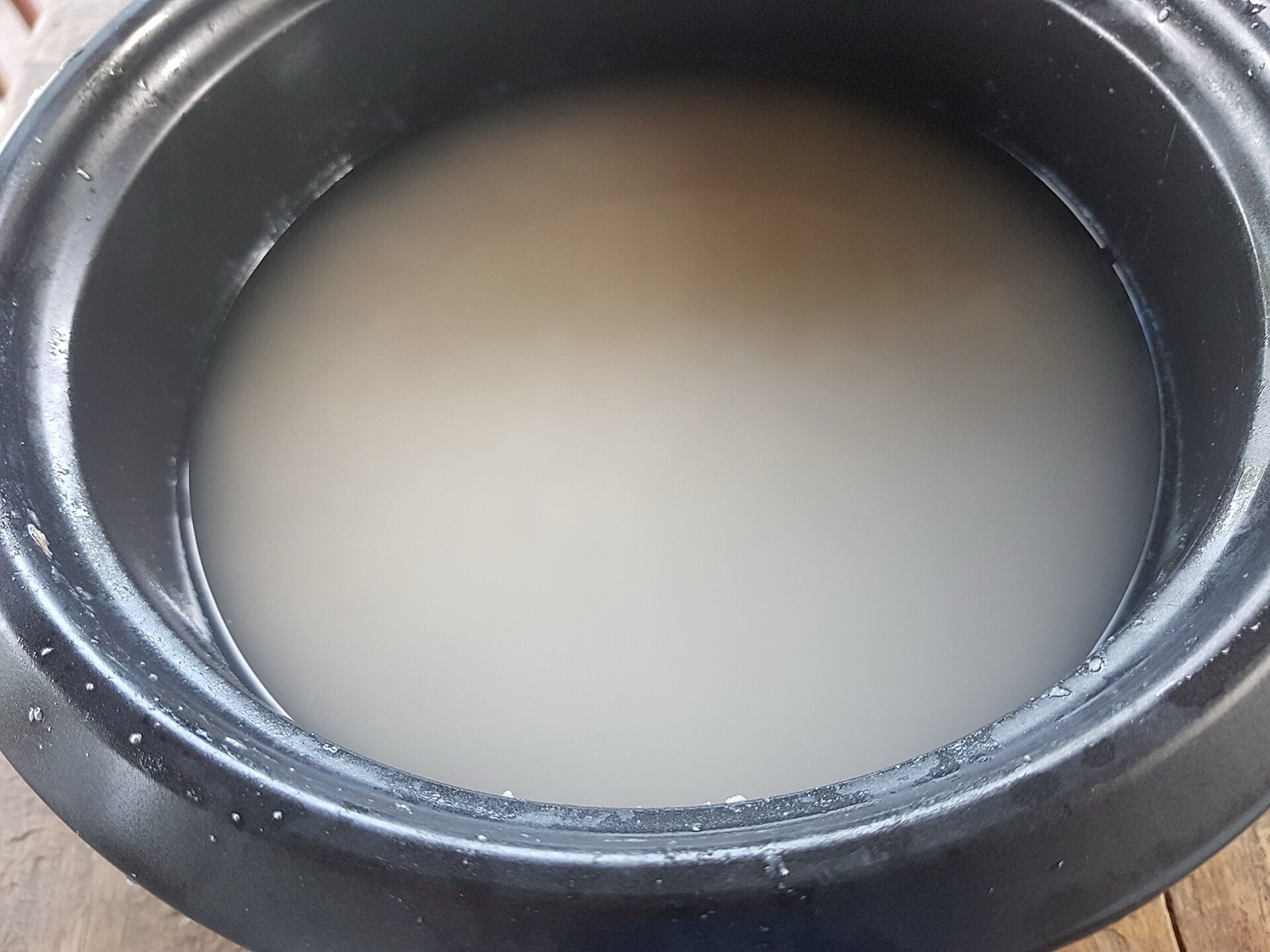
A black cooking pot seen from above, filled with cloudy, milky-white water left from washing rice. No rice grains are visible.
This is the whole subject: the cloudy water left after washing rice, photographed in a kitchen pot in the Philippines, where it is saved to thicken soups. The cloudiness is mostly starch rinsed off the grain surface. Photo: Obsidian Soul, 2022, via Wikimedia Commons. CC0 public-domain dedication.

The register

Filter by what was tested or by study type. Filtering happens in your browser; nothing is sent anywhere.

Showing all 39 sources.

Index of every source in the register
SourceTestedStudy typePeople
Marto et al. 2018 rice water in vitro + human 12 volunteers, 28 days
Hu et al. 2020 rice water (review) review —
Inamasu et al. 2010 rice water (on hair) laboratory (hair) —
Zamil et al. 2022 rice-derived ingredients (review) review —
De Paepe et al. 2002 rice starch human not stated in the abstract
Henderson et al. 2012 rice bran (review, dietary) review —
CIR rice ingredients 2006 rice-derived ingredients safety review —
Hashemi et al. 2022 rice bran extract (review) systematic review —
Takei et al. 2015 commercial ferment filtrate in vitro —
Miyamoto et al. 2023 commercial ferment filtrate (finished products) human 86 women, 12 months
Wikipedia, SK-II brand history encyclopedia (tertiary) —
Lin et al. 2005 single compound (ferulic acid) skin study (species not stated in the abstract) —
Saeedi et al. 2019 single compound (kojic acid) review —
CIR kojic acid 2010 single compound (kojic acid) safety review —
Austin et al. 2019 formulated topical agents systematic review —
AAD, fading dark spots guidance guidance —
Cleveland Clinic, facial icing ice expert opinion —
National Rosacea Society 2016 ice guidance —
Claudy 2001 cold review —
AAD, hives guidance guidance —
AAD, testing products guidance guidance —
Yamakawa et al. 2001 rice water case report 1 patient
AAD, rosacea skin care guidance guidance —
NIAMS, rosacea guidance guidance —
AAD, keratosis pilaris treatment guidance guidance —
AAD, keratosis pilaris self-care guidance guidance —
AAD, face washing guidance guidance —
FDA, microbes in cosmetics guidance guidance —
FDA, homemade cosmetics guidance guidance —
FDA, cosmetic shelf life guidance guidance —
FDA, storing food safely guidance (food) guidance —
UK Food Standards Agency guidance (food) guidance —
Gilbert et al. 1974 cooked rice (food) laboratory (food microbiology) —
Stenfors Arnesen et al. 2008 food microbiology (review) review —
Raab et al. 2009 rice (food chemistry) laboratory —
Karagas et al. 2019 rice (dietary review) review —
FDA, arsenic in food guidance (food) guidance —
Wester et al. 2004 arsenic in water animal —
ATSDR, arsenic ToxFAQs guidance guidance —

Rice water itself

Studies and reviews where the thing tested, or reviewed, was actually rice water. There are very few.

in vitro + human 12 volunteers, 28 days quotes checked November 11, 2026

Marto et al. 2018

Tested
Rice water, built into a hydrogel that was 96% rice water
Measured
Antioxidant activity and elastase inhibition in the lab; skin compatibility and sensory effects on people; a repeat insult patch test for safety
In its own words
“However, no scientific evidence supports their role in skincare products.”
“Biological and sensory effects were evaluated on a panel of 12 volunteers for 28 days.”
“The gel formulation containing 96% rice water was biocompatible with the human skin and presented suitable cosmetic properties.”
“The skin healing benefits of rice have been known for centuries.”
“Rice water presented in vitro biological antioxidant activity and elastase inhibitory effect.”
What it tells you
The closest thing to a direct test. It shows a lab-made rice-water gel was tolerated by 12 people for four weeks and had antioxidant activity in a test tube. It did not test a kitchen rinse, a splash-and-go routine, ice cubes or dark spots, and the abstract reports no comparison against a plain gel.
Source
Marto J, Neves Â, Gonçalves LM, Pinto P, Almeida C, Simões S. Rice Water: A Traditional Ingredient with Anti-Aging Efficacy. Cosmetics. 2018;5(2):26. The publisher's page refuses scripted requests, so the abstract is checked against the Directory of Open Access Journals record for the same DOI.
Used in
How to Make Rice Water for Skin: 3 Methods, Ranked · Rice Water for Dark Spots: What the Evidence Actually Says · Fermented vs Plain Rice Water: Which Actually Works Better for Your Skin? · Rice Water for Face: What It Does, What It Doesn't, How to Use It · Rice Water Ice Cubes: The Honest, Complete Guide · Yu-Su-Ru: The Thousand-Year-Old Japanese Ritual TikTok Keeps Reinventing · Rice Water — Soaked Method

review quotes checked November 11, 2026

Hu et al. 2020

Tested
Published studies on eight ingredients, rice water among them, for hyperpigmentation
Measured
Whether each ingredient had clinical (human) evidence or only lab evidence
In its own words
“Of the ingredients reviewed, soy and licorice had the most clinical evidence supporting their efficacy, while all other ingredients were supported by in vitro studies.”
What it tells you
Rice water is one of the "all other ingredients": when dermatologists went looking in 2020, the support for rice water and dark spots was lab work, not trials in people. A rinse may still be pleasant; this review is the reason we don't say it fades spots.
Source
Hu S, Wolfe S, Laughter MR, Sadeghpour M. The Use of Botanical Extracts in East Asia for Treatment of Hyperpigmentation: An Evidenced-Based Review. J Drugs Dermatol. 2020;19(7).
Used in
Rice Water for Dark Spots: What the Evidence Actually Says · Rice Water for Face: What It Does, What It Doesn't, How to Use It

History and tradition

What can be documented about where the practice comes from. Less than the internet suggests.

laboratory (hair) quotes checked November 11, 2026

Inamasu et al. 2010

Tested
Rice rinse water (yu-su-ru) and extracts of it, on hair
Measured
Hair surface friction and elasticity; the authors also reviewed the history of Japanese hair care
In its own words
“the court ladies of the Heian Period, whose beautiful long hair, called suberakashi, reached to the floor, were said to have combed their hair each day using Yu‐Su‐Ru (rinse water obtained from the washing of rice)”
“when hair was treated with Yu‐Su‐Ru alone, flaking was observed on the hair surface”
What it tells you
The one scholarly source we could verify for the Heian story, and look at its wording: the court ladies "were said to have" used it, on their hair. It is a tradition reported by cosmetic scientists, not a court record, and it says nothing about faces. The same abstract found plain rinse water left flakes on hair.
Source
Inamasu S, Ikuyama R, Fujisaki Y, Sugimoto K. The effect of rinse water obtained from the washing of rice (YU-SU-RU) as a hair treatment (abstract). Int J Cosmet Sci. September 2010. The publisher's page refuses scripted requests, so the abstract is checked against the Crossref record for the same DOI.
Used in
Rice Water Ice Cubes: The Honest, Complete Guide · Yu-Su-Ru: The Thousand-Year-Old Japanese Ritual TikTok Keeps Reinventing

Rice-derived ingredients (not rice water)

Rice starch, rice bran and its extracts. Real research, but on ingredients a kitchen rinse does not reproduce.

review quotes checked November 11, 2026

Zamil et al. 2022

Tested
Published literature on rice, rice bran and fermented rice bran in skin care
Measured
Reported benefits and safety of ingredients isolated from rice
In its own words
“Individual components of rice have been identified including phenolic compounds, betaine, squalene, tricin, and rice bran.”
“Literature suggests that rice-derived ingredients are also safe, non-irritating, and hypoallergenic.”
“Rice has been used for cosmetic purposes for centuries”
What it tells you
A short review that is friendly to rice as a cosmetic raw material. Note what it reviews: ingredients isolated from rice, mostly from the bran, which white rice has had polished off. It is background for why rice is interesting, not evidence about rinse water.
Source
Zamil DH, Khan RM, Braun TL, Nawas ZY. Dermatological uses of rice products: Trend or true? J Cosmet Dermatol. 2022;21(11):6056-6060.
Used in
Rice Water for Face: What It Does, What It Doesn't, How to Use It · Yu-Su-Ru: The Thousand-Year-Old Japanese Ritual TikTok Keeps Reinventing
human not stated in the abstract quotes checked November 11, 2026

De Paepe et al. 2002

Tested
Rice starch added to bath water
Measured
Transepidermal water loss (a barrier measure) on forearm skin irritated with a detergent, and on skin of people with atopic dermatitis
In its own words
“Exposure to rice-starch-containing bath water--twice daily for 15 min--led to a 20% improvement on the healing capacity of damaged skin.”
What it tells you
The best human evidence anywhere near this topic, and it is about soaking a forearm in starchy bath water for 15 minutes twice a day. It was not a face study, not a rinse, and not boiled rice water. Boiled rice water is starchy, so we think it is the home preparation that comes closest; that is our inference, not something the study shows.
Source
De Paepe K, Hachem JP, Vanpee E, Roseeuw D, Rogiers V. Effect of rice starch as a bath additive on the barrier function of healthy but SLS-damaged skin and skin of atopic patients. Acta Derm Venereol. 2002;82(3):184-6.
Used in
How to Make Rice Water for Skin: 3 Methods, Ranked · Fermented vs Plain Rice Water: Which Actually Works Better for Your Skin? · Rice Water for Face: What It Does, What It Doesn't, How to Use It · Rice Water for Keratosis Pilaris: Honest Look at What It Can (and Can't) Do · Rice Water for Rosacea: Read This First · Rice Water Ice Cubes: The Honest, Complete Guide · Rice Water — On-Stove (Boiled) Method
review quotes checked November 11, 2026

Henderson et al. 2012

Tested
Published literature on rice bran as food
Measured
Which bioactive compounds sit in the bran layer
In its own words
“bioactive phytochemicals present in the bran portion of the rice such as ferulic acid, tricin, β-sitosterol, γ-oryzanol, tocotrienols/tocopherols, and phytic acid”
What it tells you
We cite this for one fact only: compounds rice is known for, ferulic acid and phytic acid among them, are found in the bran. White rice is rice with the bran milled off. We found no study measuring how much of any of them ends up in water that white rice was rinsed or soaked in.
Source
Henderson AJ, Ollila CA, Kumar A, et al. Chemopreventive properties of dietary rice bran: current status and future prospects. Adv Nutr. September 2012.
Used in
Rice Water for Dark Spots: What the Evidence Actually Says · Rice Water for Face: What It Does, What It Doesn't, How to Use It
safety review quotes checked November 11, 2026

CIR rice ingredients 2006

Tested
Fourteen rice-derived cosmetic ingredients (oils, waxes, extracts, starch, proteins)
Measured
Irritation, sensitisation, toxicity and mutagenicity data
In its own words
“Rice oils, fatty acids, and waxes were, at most, mildly irritating in clinical studies.”
“The CIR Expert Panel concluded that these rice-derived ingredients are safe as cosmetic ingredients in the practices of use and concentrations as described in this safety assessment.”
What it tells you
Rice-derived ingredients have a reassuring safety record as cosmetic ingredients, at the concentrations and in the ways manufacturers use them. That is a statement about specified ingredients. It says nothing about an unpreserved jar of rice water on day four.
Source
Cosmetic Ingredient Review Expert Panel. Amended final report on the safety assessment of Oryza Sativa (Rice) Bran Oil … and Hydrolyzed Rice Protein. Int J Toxicol. 2006;25 Suppl 2:91-120.
systematic review quotes checked November 11, 2026

Hashemi et al. 2022

Tested
Rice bran extracts, for hair
Measured
Hair-growth signals and safety across ten studies
In its own words
“10 studies were analyzed: six regarding the efficacy of RB for hair growth, and four analyzing the safety profile of RB.”
“part of cultural skin and hair care practices in Asia”
What it tells you
Listed so you can see how small the literature is even for hair, where rice has the longest tradition: ten studies, all on bran extracts. Nothing here concerns faces or rinse water.
Source
Hashemi K, Pham C, Sung C, Mamaghani T, Juhasz M, Mesinkovska N. A Systematic Review: Application of Rice Products for Hair Growth. J Drugs Dermatol. 2022;21(2):177-185.
Used in
Yu-Su-Ru: The Thousand-Year-Old Japanese Ritual TikTok Keeps Reinventing

Commercial ferment filtrate (not home-fermented rice water)

Galactomyces ferment filtrate, the ingredient sold as Pitera. Often quoted as proof for home fermenting. It is a different material.

in vitro quotes checked November 11, 2026

Takei et al. 2015

Tested
Galactomyces ferment filtrate (the commercial ingredient sold as Pitera)
Measured
Barrier-protein gene expression in cultured human skin cells and a lab-grown skin model
In its own words
“GFF induced the nuclear translocation of AhR with significant and dose-dependent upregulation of CYP1A1, FLG and LOR gene expression.”
What it tells you
A cell-culture finding about one specific, industrially produced yeast filtrate. It is not rice water, and a jar left on a counter does not grow a single controlled yeast strain. It tells you nothing about what home-fermented rice water does.
Source
Takei K, Mitoma C, Hashimoto-Hachiya A, et al. Galactomyces fermentation filtrate prevents T helper 2-mediated reduction of filaggrin in an aryl hydrocarbon receptor-dependent manner. Clin Exp Dermatol. 2015;40(7):786-93.
Used in
Best Rice Ferment Essences of 2026: A Source-Based Comparison · Fermented vs Plain Rice Water: Which Actually Works Better for Your Skin? · Rice Water for Face: What It Does, What It Doesn't, How to Use It · Yu-Su-Ru: The Thousand-Year-Old Japanese Ritual TikTok Keeps Reinventing · Rice Water — Fermented Method
human 86 women, 12 months quotes checked November 11, 2026

Miyamoto et al. 2023

Tested
Three SK-II products containing Galactomyces ferment filtrate, used together twice a day
Measured
Wrinkles, pigmented spots, roughness, hydration and water loss
In its own words
“we compared facial parameters reflecting aging of the skin in 1999 and 2010 in 86 female volunteers.”
“The other authors are employees of P&G Innovation GK.”
What it tells you
A year-long study of a three-product branded routine, run by the brand owner's staff, with no untreated comparison group described in the abstract. Interesting for people shopping for essences; it cannot be read across to anything made in a kitchen.
Source
Miyamoto K, Inoue Y, Yan X, et al. Significant Reversal of Facial Wrinkle, Pigmented Spot and Roughness by Daily Application of Galactomyces Ferment Filtrate-Containing Skin Products for 12 Months. J Clin Med. 2023;12(3):1168.
Used in
Best Rice Ferment Essences of 2026: A Source-Based Comparison · Rice Water for Dark Spots: What the Evidence Actually Says · Fermented vs Plain Rice Water: Which Actually Works Better for Your Skin? · Rice Water for Face: What It Does, What It Doesn't, How to Use It · Yu-Su-Ru: The Thousand-Year-Old Japanese Ritual TikTok Keeps Reinventing · Rice Water — Fermented Method
encyclopedia (tertiary) quotes checked November 11, 2026

Wikipedia, SK-II

Tested
Nothing. An encyclopedia summary of the brand's history
Measured
Nothing measured
In its own words
“it was observed that elderly workers at a sake brewery had smooth, clear and young-looking hands”
“A yeast extract that the company calls Pitera was eventually isolated for cosmetic use and the brand was launched in the early 1980s.”
What it tells you
The sake-brewery story is the brand's origin story, repeated by an encyclopedia anyone can edit. We tell it as a story the company tells. It is about a yeast extract, which is why it is no evidence for rice water. Wikipedia text changes; if these sentences are edited away our check will fail and the entry will be pulled.
Source
Wikipedia contributors. SK-II. Wikipedia, The Free Encyclopedia.
Used in
Best Rice Ferment Essences of 2026: A Source-Based Comparison · Fermented vs Plain Rice Water: Which Actually Works Better for Your Skin? · Rice Water for Face: What It Does, What It Doesn't, How to Use It · Yu-Su-Ru: The Thousand-Year-Old Japanese Ritual TikTok Keeps Reinventing

Single compounds

Ferulic acid, kojic acid and other named molecules, tested alone or in formulated products at known concentrations.

skin study (species not stated in the abstract) quotes checked November 11, 2026

Lin et al. 2005

Tested
Ferulic acid added to a 15% vitamin C + 1% vitamin E solution
Measured
Redness and sunburn-cell formation after simulated sunlight
In its own words
“Ferulic acid is a potent ubiquitous plant antioxidant.”
“doubled photoprotection to solar-simulated irradiation of skin from 4-fold to approximately 8-fold as measured by both erythema and sunburn cell formation”
What it tells you
The study behind ferulic acid's reputation. It tested a measured dose inside a vitamin C and E serum. It supports buying a formulated antioxidant serum, not the idea that rinse water from polished rice delivers ferulic acid. It also shows ferulic acid protecting against light damage, which is the opposite of making skin sun-sensitive.
Source
Lin FH, Lin JY, Gupta RD, et al. Ferulic acid stabilizes a solution of vitamins C and E and doubles its photoprotection of skin. J Invest Dermatol. 2005;125(4):826-32.
Used in
Rice Water for Dark Spots: What the Evidence Actually Says · Rice Water for Face: What It Does, What It Doesn't, How to Use It
review quotes checked November 11, 2026

Saeedi et al. 2019

Tested
Published literature on kojic acid
Measured
How kojic acid works and where it is used
In its own words
“Kojic acid (KA) is a natural metabolite produced by fungi that has the ability to inhibit tyrosinase activity in synthesis of melanin.”
What it tells you
Kojic acid is made by particular fungi. Rice water left out at home ferments with whatever microbes arrive, and we found no study showing that process produces kojic acid in a useful amount, or at all. Claims that home-fermented rice water "contains kojic acid" are not supported by anything in this register.
Source
Saeedi M, Eslamifar M, Khezri K. Kojic acid applications in cosmetic and pharmaceutical preparations. Biomed Pharmacother. 2019;110:582-593.
Used in
How to Make Rice Water for Skin: 3 Methods, Ranked · Rice Water for Dark Spots: What the Evidence Actually Says · Fermented vs Plain Rice Water: Which Actually Works Better for Your Skin? · Rice Water for Face: What It Does, What It Doesn't, How to Use It · Rice Water — Fermented Method
safety review quotes checked November 11, 2026

CIR kojic acid 2010

Tested
Kojic acid as a cosmetic ingredient
Measured
Toxicity, sensitisation and skin-lightening data
In its own words
“The Cosmetic Ingredient Review (CIR) Expert Panel concluded that the 2 end points of concern, dermal sensitization and skin lightening, would not be seen at use concentrations below 1%; therefore, this ingredient is safe for use in cosmetic products up to that level.”
What it tells you
Useful if you buy a kojic acid product: the safety panel's comfort level is 1%. It also shows kojic acid is a real sensitiser at higher strengths, one more reason to prefer a labelled product over guessing.
Source
Burnett CL, Bergfeld WF, Belsito DV, et al. Final report of the safety assessment of Kojic acid as used in cosmetics. Int J Toxicol. 2010;29(6 Suppl):244S-73.
Used in
Rice Water for Dark Spots: What the Evidence Actually Says · Fermented vs Plain Rice Water: Which Actually Works Better for Your Skin?
systematic review quotes checked November 11, 2026

Austin et al. 2019

Tested
35 randomised trials of topical agents for melasma, kojic acid among them
Measured
Which agents earned a clinical recommendation
In its own words
“Natural compounds are associated with low risk for adverse events, but more research is needed to determine the efficacy, optimal formulation, and appropriate concentration of novel treatments.”
What it tells you
Where real trials exist for pigment, they are trials of formulated products at stated strengths. Rice water was not among the agents with a trial. For melasma, that means a dermatologist, not a rinse.
Source
Austin E, Nguyen JK, Jagdeo J. Topical Treatments for Melasma: A Systematic Review of Randomized Controlled Trials. J Drugs Dermatol. 2019;18(11):1156-1171.
Used in
Rice Water for Dark Spots: What the Evidence Actually Says
guidance quotes checked November 11, 2026

AAD, fading dark spots

Tested
Dermatologist guidance for the public
Measured
What to do first, and which over-the-counter ingredients have a track record
In its own words
“Effective treatment for dark spots and patches begins with sunscreen.”
“These ingredients can fade existing dark spots.”
“When your skin is no longer irritated, new dark spots tend to stop appearing and existing spots often clear on their own over time.”
“A spot that is a few shades darker than your natural skin color will usually fade within 6 to 12 months.”
“You may have success with a product that you can buy without a prescription.”
“use a product that contains one of the following ingredients: Azelaic acid Glycolic acid Kojic acid”
What it tells you
"These ingredients" on the AAD page are azelaic acid, glycolic acid, kojic acid, retinoids and vitamin C, in products. Rice water is not on the list. Sunscreen comes first whatever else you do. The page also explains why home remedies collect glowing testimonials: once the cause stops, many spots fade by themselves over months.
Source
American Academy of Dermatology. How to fade dark spots in darker skin tones.
Used in
Rice Water for Dark Spots: What the Evidence Actually Says

Cold and ice on skin

What clinical and patient-group sources say about putting ice on a face.

expert opinion quotes checked November 11, 2026

Cleveland Clinic, facial icing

Tested
Plain ice on the face; an aesthetician's advice, not a study
Measured
Nothing measured. Practical dos and don'ts
In its own words
“Don't let the ice rest on any portion of your skin for too long, as it could cause the aforementioned irritation and redness — and even frostbite.”
“If you can see a spider web of little red lines under your skin, avoid ice, which can make them worse and prevent healing.”
“isn't a cure-all or a long-term fix for skin problems like acne, genetic under-eye bags, wrinkles or other issues.”
“You shouldn't do it more than once a day”
“If you're recovering from cosmetic surgery, lasers, peels or another procedure, skip facial icing”
“wrap an ice cube in a thin cloth, which will protect the skin on your face and your hands”
“can specifically reduce the appearance of a puffy under-eye area”
What it tells you
This is where the site's ice rules come from: wrap the cube, keep it moving, no more than once a day, and skip it over visible broken capillaries. It is opinion from a skin-care professional, published by a hospital. The benefits it describes are temporary and come from the cold, with or without rice.
Source
Cleveland Clinic Health Essentials. Facial icing (interview with aesthetician Lori Scarso).
Used in
Rice Water for Keratosis Pilaris: Honest Look at What It Can (and Can't) Do · Rice Water Ice Cubes for Under-Eye Bags: Does It Actually Work? · Rice Water for Rosacea: Read This First · Rice Water Ice Cubes: The Honest, Complete Guide
guidance quotes checked November 11, 2026

National Rosacea Society 2016

Tested
A reader's question about ice cubes on rosacea-prone skin
Measured
Nothing measured
In its own words
“Although the exact mechanism of cooling has not been extensively studied scientifically”
“However, cold can be a trigger for flare-ups in many sufferers, so be cautious and discontinue the practice if you notice any irritation.”
“Also, it's best not to apply ice cubes directly to the skin.”
What it tells you
The patient society's own answer: cooling might calm some people, cold is a flare trigger for many, and bare ice on skin is discouraged either way. That is why the rosacea article says to leave the cubes out.
Source
National Rosacea Society. Q&A: Skin Sensitivity & Ice Cubes. Rosacea Review, Spring 2016.
Used in
Rice Water Ice Cubes for Under-Eye Bags: Does It Actually Work? · Rice Water for Rosacea: Read This First · Rice Water Ice Cubes: The Honest, Complete Guide
review quotes checked November 11, 2026

Claudy 2001

Tested
Clinical review of cold urticaria
Measured
How the condition is diagnosed and managed
In its own words
“The diagnosis is based on history taking and the ice cube test.”
What it tells you
Hives triggered by cold are diagnosed by a clinician holding an ice cube to skin. If cold has ever raised welts on you, an ice-cube ritual is the trigger itself. See a clinician; don't run the test on your own face.
Source
Claudy A. Cold urticaria. J Investig Dermatol Symp Proc. 2001;6(2):141-2.
Used in
Rice Water Ice Cubes for Under-Eye Bags: Does It Actually Work? · Rice Water Ice Cubes: The Honest, Complete Guide
guidance quotes checked November 11, 2026

AAD, hives

Tested
Dermatologist guidance for the public
Measured
What can set off hives
In its own words
“Something physical touching your skin (e.g., sunlight, pressure, or cold)”
What it tells you
Cold is a recognised physical trigger for hives. Raised, itchy welts after icing mean stop.
Source
American Academy of Dermatology. Hives: FAQs.
Used in
Rice Water Ice Cubes for Under-Eye Bags: Does It Actually Work? · Rice Water Ice Cubes: The Honest, Complete Guide

Patch testing, allergy and condition guidance

Dermatology guidance the site leans on for who should skip this and how to test first.

guidance quotes checked November 11, 2026

AAD, testing products

Tested
Dermatologist guidance for the public
Measured
How to patch test at home
In its own words
“Apply the product to a test spot twice daily for seven to 10 days.”
“Choose a quarter-sized spot on your skin where the product won't be rubbed or washed away, such as the underside of your arm or the bend of your elbow.”
What it tells you
The patch-test method on this site is the AAD's, unchanged. Note the length: seven to ten days, not one night. With rice water that means making fresh batches during the test rather than using one ageing jar.
Source
American Academy of Dermatology. How to test skin care products.
Used in
How to Make Rice Water for Skin: 3 Methods, Ranked · Rice Water for Dark Spots: What the Evidence Actually Says · Rice Water for Face: What It Does, What It Doesn't, How to Use It · Rice Water for Keratosis Pilaris: Honest Look at What It Can (and Can't) Do · Rice Water Ice Cubes for Under-Eye Bags: Does It Actually Work? · Rice Water for Rosacea: Read This First · Rice Water Ice Cubes: The Honest, Complete Guide · Rice Water — On-Stove (Boiled) Method · Rice Water — Fermented Method · Rice Water — Soaked Method
case report 1 patient quotes checked November 11, 2026

Yamakawa et al. 2001

Tested
Water used to wash rice, on one patient's skin
Measured
Skin reaction to rice-washing water (handling test, prick test, histamine release)
In its own words
“A 30-year-old man with atopic dermatitis had had erythema and itching of the hands after washing rice in water, though he had always eaten cooked rice without problems.”
What it tells you
One documented person reacted to rice-washing water on his skin while eating rice with no trouble. One case shows it can happen, not how often, and it is exactly this site's product. Being able to eat rice is not proof your skin will accept it, which is why the patch test matters.
Source
Yamakawa Y, Ohsuna H, Aihara M, Tsubaki K, Ikezawa Z. Contact urticaria from rice. Contact Dermatitis. 2001;44(2):91-3.
Used in
Rice Water for Face: What It Does, What It Doesn't, How to Use It · Rice Water for Rosacea: Read This First
guidance quotes checked November 11, 2026

AAD, rosacea skin care

Tested
Dermatologist guidance for the public
Measured
Skin-care habits for rosacea
In its own words
“Never use an astringent or toner.”
“Test skin care products and makeup before applying them to your face.”
What it tells you
Rice water is used as a toner. For rosacea the AAD's advice is no toners at all, and to test anything new first. We report that plainly rather than argue rice water is an exception; nobody has tested whether it is.
Source
American Academy of Dermatology. 7 rosacea skin care tips dermatologists recommend.
Used in
Fermented vs Plain Rice Water: Which Actually Works Better for Your Skin? · Rice Water for Rosacea: Read This First
guidance quotes checked November 11, 2026

NIAMS, rosacea

Tested
U.S. government health guidance
Measured
Common triggers and self-care
In its own words
“Treat your skin gently. Wash your face with cleansers made for sensitive skin, and moisturize regularly. Avoid exfoliants and products that contain alcohol.”
“Triggers vary among individuals”
“Hot or cold weather.”
What it tells you
The same page lists hot or cold weather among common triggers. Fermented rice water is sour and its contents vary by batch, so it is the wrong version for skin that is meant to be treated gently.
Source
National Institute of Arthritis and Musculoskeletal and Skin Diseases (NIH). Rosacea: Diagnosis, Treatment, and Steps to Take.
Used in
Fermented vs Plain Rice Water: Which Actually Works Better for Your Skin? · Rice Water for Rosacea: Read This First · Rice Water — Fermented Method
guidance quotes checked November 11, 2026

AAD, keratosis pilaris treatment

Tested
Dermatologist guidance for the public
Measured
What a treatment plan includes
In its own words
“A creamy moisturizer can soothe the itch and dryness.”
What it tells you
The AAD names urea and lactic acid creams, and prescription exfoliants, as the things that work. Rice water is not mentioned. At best a rinse is a gentle extra before the moisturiser that does the work.
Source
American Academy of Dermatology. Keratosis pilaris: Diagnosis and treatment.
Used in
Rice Water for Keratosis Pilaris: Honest Look at What It Can (and Can't) Do
guidance quotes checked November 11, 2026

AAD, keratosis pilaris self-care

Tested
Dermatologist guidance for the public
Measured
At-home routine
In its own words
“Avoid scrubbing your skin, which tends to irritate the skin and worsen keratosis pilaris.”
“Applying too much or using it more often than indicated can cause raw, irritated skin.”
“Exfoliate gently.”
“Apply a product called a keratolytic.”
What it tells you
Relevant because rice-grain scrubs get recommended for bumpy arms. Scrubbing is the thing dermatologists say makes it worse.
Source
American Academy of Dermatology. Keratosis pilaris: Self-care.
Used in
Rice Water for Keratosis Pilaris: Honest Look at What It Can (and Can't) Do
guidance quotes checked November 11, 2026

AAD, face washing

Tested
Dermatologist guidance for the public
Measured
Basic cleansing habits
In its own words
“Rinse with lukewarm water and pat dry with a soft towel.”
What it tells you
The baseline routine any rice-water step sits on top of. Lukewarm, gentle, pat dry.
Source
American Academy of Dermatology. Face washing 101.
Used in
Rice Water for Face: What It Does, What It Doesn't, How to Use It · Rice Water Ice Cubes for Under-Eye Bags: Does It Actually Work? · Rice Water for Rosacea: Read This First

Contamination and storage

Food-safety and cosmetic-safety sources. None of them tested rice water as a skincare liquid; they are the nearest authoritative rules.

guidance quotes checked November 11, 2026

FDA, microbes in cosmetics

Tested
U.S. regulator guidance
Measured
How cosmetics become contaminated and how users can avoid it
In its own words
“Don't add water or saliva to cosmetic products, such as mascara. You may be adding harmful microorganisms.”
“Some microorganisms may grow faster in warm or damp storage conditions, and preservatives in the product may break down.”
What it tells you
The FDA treats added water as a contamination risk even in preserved products. Rice water is water plus starch with no preservative at all. That is the whole case for small batches, clean jars and the fridge.
Source
U.S. Food and Drug Administration. Microbiological Safety and Cosmetics.
Used in
How to Make Rice Water for Skin: 3 Methods, Ranked · Fermented vs Plain Rice Water: Which Actually Works Better for Your Skin? · Rice Water Ice Cubes for Under-Eye Bags: Does It Actually Work? · Rice Water Shelf Life: Fridge, Freezer, and When to Toss It · Rice Water — Fermented Method · Rice Water — Soaked Method
guidance quotes checked November 11, 2026

FDA, homemade cosmetics

Tested
U.S. regulator guidance
Measured
What is expected of anyone making cosmetics
In its own words
“Cosmetics do not have to be sterile, but they must not contain any harmful microorganisms, and the number of aerobic microorganisms per gram must be low.”
What it tells you
Written for people who sell what they make, but the standard is a useful yardstick: low microbial counts. Nobody can check that at home, which is why this site will not print a shelf life for rice water.
Source
U.S. Food and Drug Administration. Small Businesses & Homemade Cosmetics: Fact Sheet.
Used in
Rice Water Shelf Life: Fridge, Freezer, and When to Toss It
guidance quotes checked November 11, 2026

FDA, cosmetic shelf life

Tested
U.S. regulator guidance
Measured
What shortens a product's safe life
In its own words
“Exposure to moisture, such as in a bathroom, may make it easier for bacteria and fungi to grow.”
“FDA considers determining a product's shelf life to be part of the manufacturer's responsibility.”
What it tells you
Shelf life is something a manufacturer establishes by testing. With a home preparation there is no manufacturer and no test. Any day-count you read for rice water, here or elsewhere, is a habit, not a finding.
Source
U.S. Food and Drug Administration. Shelf Life and Expiration Dating of Cosmetics.
Used in
Rice Water Shelf Life: Fridge, Freezer, and When to Toss It
guidance quotes checked November 11, 2026

FDA, storing food safely

Tested
U.S. regulator guidance for food
Measured
Time and temperature rules for perishable food
In its own words
“Stick to the "two-hour rule" for leaving items needing refrigeration out at room temperature.”
“Keep the refrigerator temperature at or below 40° F (4° C). The freezer temperature should be 0° F (-18° C).”
“Be aware that food can make you very sick even when it doesn't look, smell, or taste spoiled.”
“one hour if the air temperature is above 90° F”
What it tells you
A food rule, borrowed. Rice water is a perishable starch liquid, so we apply the two-hour rule to it: in the fridge or freezer within two hours of straining. The third quote is why a sniff test is a reason to throw a batch out, never proof that it is fine.
Source
U.S. Food and Drug Administration. Are You Storing Food Safely?
Used in
How to Make Rice Water for Skin: 3 Methods, Ranked · Fermented vs Plain Rice Water: Which Actually Works Better for Your Skin? · Rice Water for Face: What It Does, What It Doesn't, How to Use It · Rice Water Shelf Life: Fridge, Freezer, and When to Toss It · Rice Water Ice Cubes: The Honest, Complete Guide · Rice Water — On-Stove (Boiled) Method · Rice Water — Fermented Method · Rice Water — Soaked Method
guidance quotes checked November 11, 2026

UK Food Standards Agency

Tested
UK regulator guidance for food
Measured
How long leftovers keep chilled; what freezing does
In its own words
“Eat leftovers within 48 hours or freeze them if you think this won't be possible.”
“A freezer acts as a pause button - food in a freezer won't go bad and most bacteria cannot grow in it.”
“This process affects the quality of the foods, rather than the safety.”
“It's also important to use food within 24 hours after it's been fully defrosted”
What it tells you
The only day-count on this site comes from here, and it is a rule for leftover food: 48 hours in the fridge, otherwise freeze. We use it as a ceiling for refrigerated rice water because it is the most cautious official number we could verify, not because anyone tested rice water. For frozen cubes there is no sourced use-by date; freezing pauses growth and long storage is described as a quality issue.
Source
Food Standards Agency (UK). How to chill, freeze and defrost food safely. Published 18 December 2017.
Used in
How to Make Rice Water for Skin: 3 Methods, Ranked · Rice Water for Face: What It Does, What It Doesn't, How to Use It · Rice Water for Keratosis Pilaris: Honest Look at What It Can (and Can't) Do · Rice Water Shelf Life: Fridge, Freezer, and When to Toss It · Rice Water Ice Cubes: The Honest, Complete Guide · Rice Water — On-Stove (Boiled) Method · Rice Water — Soaked Method
laboratory (food microbiology) quotes checked November 11, 2026

Gilbert et al. 1974

Tested
Boiled rice stored at 4 to 55 °C
Measured
Survival of B. cereus spores through cooking and their growth during storage
In its own words
“The spores of B. cereus survived cooking and were capable of germination and outgrowth.”
“After boiling the rice should either be kept hot (> 63 degrees C.) or cooled quickly and transferred to a refrigerator within 2 hr. of cooking.”
What it tells you
Boiling does not sterilise rice: this bacterium's spores survive it and grow as the pot cools. The study is about eating rice, and food poisoning is an eating problem. We cite it because the boiled method leaves you with exactly the warm, starchy liquid the spores like, so it should not sit out.
Source
Gilbert RJ, Stringer MF, Peace TC. The survival and growth of Bacillus cereus in boiled and fried rice in relation to outbreaks of food poisoning. J Hyg (Lond). 1974;73(3):433-44.
Used in
How to Make Rice Water for Skin: 3 Methods, Ranked · Rice Water Shelf Life: Fridge, Freezer, and When to Toss It · Rice Water — On-Stove (Boiled) Method
review quotes checked November 11, 2026

Stenfors Arnesen et al. 2008

Tested
Review of Bacillus cereus
Measured
Where the organism lives and how it causes illness
In its own words
“Bacillus cereus is widespread in nature and frequently isolated from soil and growing plants”
What it tells you
Why raw rice carries these spores in the first place. What they do on skin, as opposed to in a stomach, is not something we found studied; we treat old rice water as something to bin, and keep it away from eyes and broken skin.
Source
Stenfors Arnesen LP, Fagerlund A, Granum PE. From soil to gut: Bacillus cereus and its food poisoning toxins. FEMS Microbiol Rev. 2008;32(4):579-606.
Used in
Rice Water Shelf Life: Fridge, Freezer, and When to Toss It

Arsenic in rice

Why rice carries arsenic, how much rinsing moves into the water, and what is known about skin contact.

laboratory quotes checked November 11, 2026

Raab et al. 2009

Tested
Rinsing and cooking of basmati, long-grain, white and brown rice
Measured
Total and inorganic arsenic left in the rice
In its own words
“Rinse washing was effective at removing circa. 10% of the total and inorganic arsenic from basmati rice, but was less effective for other rice types.”
What it tells you
Arsenic that rinsing removes from the rice goes into the rinse water. This is the reason every recipe here pours away the first rinse before the soak. The study measured the rice, not the water, so nobody can tell you the concentration in your jar.
Source
Raab A, Baskaran C, Feldmann J, Meharg AA. Cooking rice in a high water to rice ratio reduces inorganic arsenic content. J Environ Monit. 2009;11(1):41-4.
Used in
How to Make Rice Water for Skin: 3 Methods, Ranked · Rice Water Ice Cubes: The Honest, Complete Guide · Rice Water — On-Stove (Boiled) Method · Rice Water — Fermented Method · Rice Water — Soaked Method
review quotes checked November 11, 2026

Karagas et al. 2019

Tested
Epidemiology of eating rice
Measured
Health outcomes linked to arsenic from rice in the diet
In its own words
“Rice is a major staple food worldwide and a dietary source of arsenic.”
What it tells you
The concern in the literature is eating rice for years. This review does not address skin contact at all. Do not drink rice water made for your face.
Source
Karagas MR, Punshon T, Davis M, et al. Rice Intake and Emerging Concerns on Arsenic in Rice: a Review of the Human Evidence and Methodologic Challenges. Curr Environ Health Rep. December 2019.
guidance quotes checked November 11, 2026

FDA, arsenic in food

Tested
U.S. regulator guidance
Measured
Health effects of arsenic exposure through food
In its own words
“For adults, long-term exposure to inorganic arsenic has been associated with skin disorders and increased risks for skin, bladder, and lung cancers, and for cardiovascular disease.”
What it tells you
These are effects of long-term intake by mouth. They are the reason arsenic in rice is taken seriously, not evidence that a rinse on skin causes them.
Source
U.S. Food and Drug Administration. Arsenic in Food.
animal quotes checked November 11, 2026

Wester et al. 2004

Tested
Arsenic dissolved in water, applied to monkey skin
Measured
How much of the applied arsenic was absorbed through skin
In its own words
“absorption rates (0.6-4.4% absorption) are consistent with prior research using the more sensitive, radiolabeled technique”
What it tells you
Dissolved arsenic does cross skin, a little: a few percent of what was applied, in monkeys. Low is not zero. Because nobody has measured how much arsenic is in cosmetic rice water, this cannot tell you how much reaches you. Our habits of discarding the first rinse, not leaving it on for hours, and keeping it off broken skin are precautions, not conclusions from this study.
Source
Wester RC, Hui X, Barbadillo S, et al. In vivo percutaneous absorption of arsenic from water and CCA-treated wood residue. Toxicol Sci. 2004;79(2):287-95.
Used in
Rice Water Ice Cubes: The Honest, Complete Guide
guidance quotes checked November 11, 2026

ATSDR, arsenic ToxFAQs

Tested
U.S. government toxicology summary
Measured
Health effects by route of exposure
In its own words
“Skin contact with inorganic arsenic may cause redness and swelling.”
What it tells you
A general statement about direct contact with arsenic compounds, typically at workplace levels. No source we found measures arsenic in cosmetic rice water or reports harm from it. We list it so the unknown is stated, not hidden.
Source
Agency for Toxic Substances and Disease Registry (CDC). ToxFAQs for Arsenic.

Looked for, not found

Popular claims with nothing behind them yet

On November 11, 2026 we ran these exact searches on PubMed, the U.S. National Library of Medicine's index. A search that finds nothing is not proof that something is false. It is the reason this site does not repeat the claim.

Rice-water ice cubes do something that plain ice does not

Search "rice water"[tiab] AND ice[tiab]

0 records

No study of any kind. Every benefit we can source for the cubes is a benefit of cold.

Rice water helps rosacea or keratosis pilaris

Search "rice water"[tiab] AND (rosacea OR "keratosis pilaris")

0 records

No study. Our articles on both conditions rest on dermatology guidance about the condition, not on rice-water research.

Inositol in rice water benefits facial skin

Search inositol[ti] AND topical[tiab] AND (skin[tiab] OR facial[tiab]) AND (trial OR volunteers)

0 records

We found no human trial of topical inositol for facial skin, and no measurement of inositol in rinse water.

Home-fermented rice water is better for skin than plain

Search "fermented rice water"[tiab]

13 records

Going by their titles, the 13 concern probiotics, plant growth, fish, food and a mouse wound model. None is a study of people applying fermented rice water to their faces. The human ferment studies in this register used a commercial yeast filtrate.

Rice water for skin has been studied a lot

Search "rice water"[tiab] AND (skin[tiab] OR face[tiab] OR facial[tiab])

8 records

Going by their titles, two concern rice water as skin care (a review of East Asian botanicals, listed above, and a 2025 analysis of TikTok videos that has no abstract to quote). The rest are about farming, arsenic, wound dressings or diarrhoea management.

A tested shelf life for homemade rice water

Search "rice water"[tiab] AND (shelf[tiab] OR storage[tiab] OR spoilage[tiab])

11 records

Going by their titles, none tests how long a home-made cosmetic rice water stays usable. The storage guidance on this site is borrowed from food-safety rules and labelled as such.

Left out: sources we could not verify

If a source can't be fetched and quoted, it is not in the register, however well known it is.

How the check works

The register is a single data file. A small script fetches each source's address, strips the page down to text, and looks for every quote exactly as written. PubMed records are read through the National Library of Medicine's own programming interface. If a page can't be fetched, the script reports the source as unverified and fails; it never assumes a quote is still there.

We quote abstracts and public pages, not full papers behind paywalls. That limits us: details such as sample size are sometimes only in the full text, and where the abstract doesn't state them the entry says so.

What changed in the last review is on the updates page. How we choose sources is in How We Source.