Recipe
Rice Water — On-Stove (Boiled) Method
The starch-rich version. Simmering pulls more starch from the grain than soaking does, and starch is the rice ingredient with the best human skin research, from a bath-additive study on forearms.
Ingredients
- ½ cup plain white rice any variety
- 2–3 cups water start with 2 cups; add more if it reduces too fast
Equipment
- Small saucepan
- Fine-mesh strainer
- Clean glass jar with airtight lid
Why this method
Simmering rice releases much more starch than a cold soak, so this is the thick, milky version.
Starch is the one rice ingredient with decent human skin research. In a Belgian study, volunteers whose forearm skin had been irritated with detergent soaked it in bath water containing rice starch for 15 minutes twice a day, and it recovered better: “a 20% improvement on the healing capacity of damaged skin” [De Paepe et al. 2002].
An earlier version of this page said that research was “built on this preparation”. It wasn’t. It used rice starch as a bath additive, on arms. Boiled rice water is the home preparation that comes closest, which is as much as we can say.
Step-by-step
1. Rinse the rice and discard the rinse (30 seconds)
Cover ½ cup of rice with water, swirl, and pour the water away. Some of the arsenic rice carries leaves with it [Raab et al. 2009].
2. Combine rice and water (30 seconds)
Put the rinsed rice in the saucepan with 2 cups of fresh water.
3. Bring to a gentle simmer (3–4 minutes)
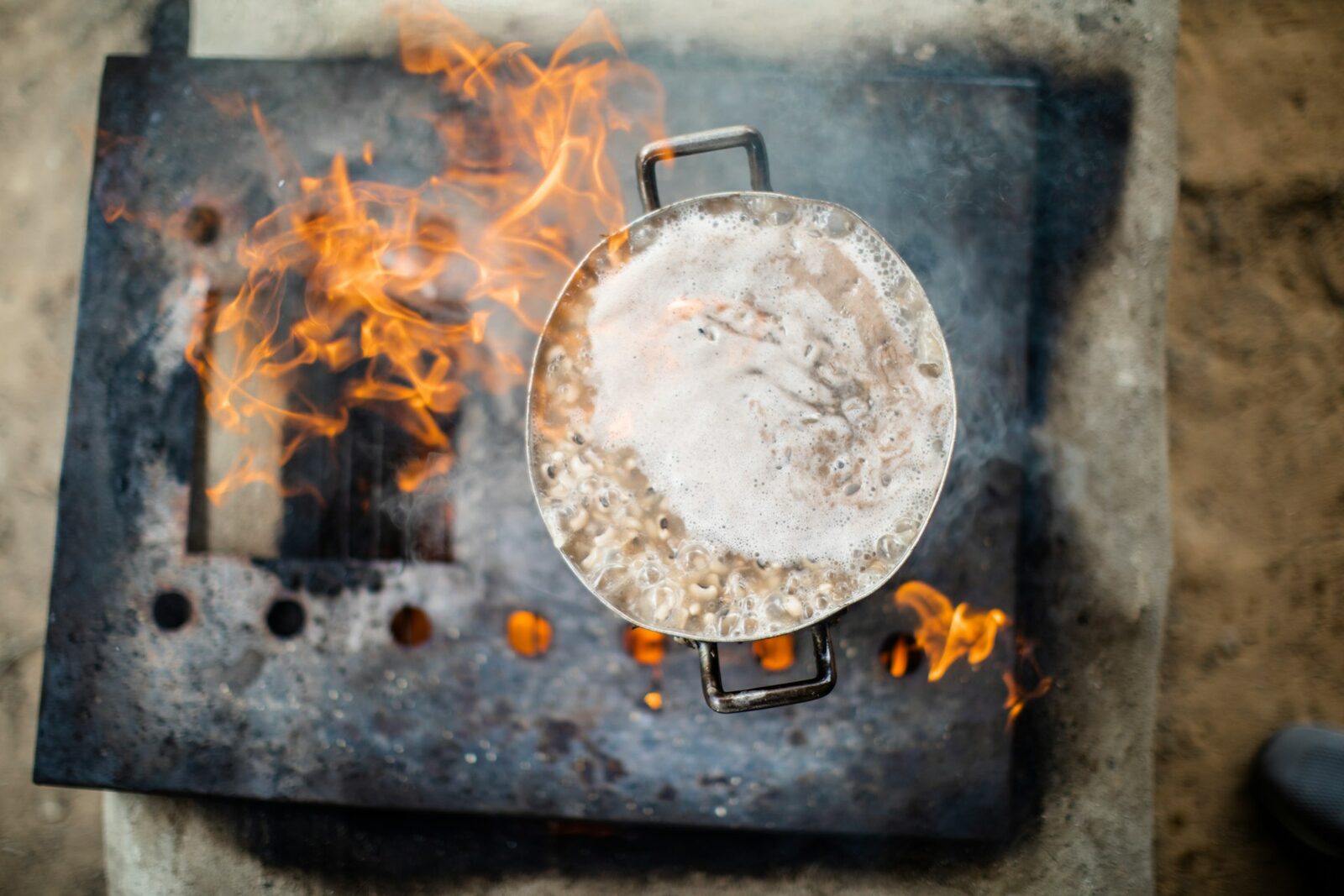
Medium heat, lid off, until small bubbles break the surface. Turn it down.
4. Simmer for 10–15 minutes
Stir now and then. The water turns opaque and slightly thick. If the level drops fast, add up to another cup of water. Stop when the rice is soft.
5. Strain and cool quickly (5–10 minutes)
Strain the liquid into the clean jar. Stand the jar in a bowl of cold water and stir it once or twice so it cools fast.
6. Refrigerate or freeze within two hours
This step matters more here than in any other method. Rice carries the spores of a bacterium that cooking doesn’t kill: “The spores of B. cereus survived cooking and were capable of germination and outgrowth.” [Gilbert et al. 1974] The same research advised cooling cooked rice quickly and refrigerating it “within 2 hr. of cooking.” A warm jar of starchy liquid left on the stove is the situation that advice exists for.
Tips for a better batch
- It thickens as it cools. If it sets to a gel in the fridge, stir in a little clean water when you use it.
- For a forearm or hand soak like the study’s, stir a cup or two into a basin of lukewarm water.
- For ice cubes, cool it first, then pour. The batch calculator gives cube counts.
- Date the jar. The use-by helper applies the 48-hour fridge rule we borrow from food guidance [UK Food Standards Agency].
Warnings
- Patch test before using it on your face [AAD, testing products].
- Boiling is not sterilising. Don’t keep this version longer because it was cooked.
- The starch film can feel heavy on oily skin. Rinse it off after a few minutes, or switch to the soaked method.
- Keep it away from eyes, lips and broken skin. Don’t drink it.
- Never apply it warm from the pan; let it cool completely.
When to choose this method over others
When you want the starchier version, particularly for body skin such as forearms, hands and shins, which is where the starch research was done.
For a gentler everyday preparation, see the soaked method. For the fermented version and its caveats, see the fermented method.
Related
Storage
Cool it quickly, then refrigerate or freeze within 2 hours of cooking: boiling does not kill the spores rice carries. Use a refrigerated jar within 48 hours or freeze it. These are borrowed food rules, not a tested shelf life; frozen cubes have no sourced use-by date.
Frequently asked questions
Why boiled instead of soaked?
Simmering draws far more starch out of the rice, so the liquid is thicker. The best human evidence near this topic is a study in which rice starch added to bath water helped irritated forearm skin recover. That study did not test boiled rice water, so it is a reason to be interested, not proof.
Should the water actually boil, or just simmer?
A gentle simmer. A hard boil evaporates the water quickly and can catch on the bottom of the pan.
Can I eat the leftover rice?
Yes. It is simply rice cooked in extra water. Eat it straight away or cool it quickly and refrigerate it within two hours, as you would any cooked rice.
Why does this version feel heavier on skin?
It contains more starch, which dries to a thin film. If that feels tight or sticky, rinse it off after a few minutes or dilute the batch.
Can I dilute boiled rice water to make it lighter?
Yes. Add cool, clean water at the time of use. Don't store diluted rice water any longer than undiluted.
Sources for this page
Each line is an entry in the evidence register. The quoted passage was found in the source, word for word, on November 11, 2026.
- De Paepe et al. 2002 · human · not stated in the abstract · tested: Rice starch added to bath water
“Exposure to rice-starch-containing bath water--twice daily for 15 min--led to a 20% improvement on the healing capacity of damaged skin.”
De Paepe K, Hachem JP, Vanpee E, Roseeuw D, Rogiers V. Effect of rice starch as a bath additive on the barrier function of healthy but SLS-damaged skin and skin of atopic patients. Acta Derm Venereol. 2002;82(3):184-6. - Gilbert et al. 1974 · laboratory (food microbiology) · tested: Boiled rice stored at 4 to 55 °C
“The spores of B. cereus survived cooking and were capable of germination and outgrowth.”
Gilbert RJ, Stringer MF, Peace TC. The survival and growth of Bacillus cereus in boiled and fried rice in relation to outbreaks of food poisoning. J Hyg (Lond). 1974;73(3):433-44. - Raab et al. 2009 · laboratory · tested: Rinsing and cooking of basmati, long-grain, white and brown rice
“Rinse washing was effective at removing circa. 10% of the total and inorganic arsenic from basmati rice, but was less effective for other rice types.”
Raab A, Baskaran C, Feldmann J, Meharg AA. Cooking rice in a high water to rice ratio reduces inorganic arsenic content. J Environ Monit. 2009;11(1):41-4. - FDA, storing food safely · guidance · tested: U.S. regulator guidance for food
“Stick to the "two-hour rule" for leaving items needing refrigeration out at room temperature.”
U.S. Food and Drug Administration. Are You Storing Food Safely? - UK Food Standards Agency · guidance · tested: UK regulator guidance for food
“Eat leftovers within 48 hours or freeze them if you think this won't be possible.”
Food Standards Agency (UK). How to chill, freeze and defrost food safely. Published 18 December 2017. - AAD, testing products · guidance · tested: Dermatologist guidance for the public
“Apply the product to a test spot twice daily for seven to 10 days.”
American Academy of Dermatology. How to test skin care products.