Recipe
Rice Water — Soaked Method
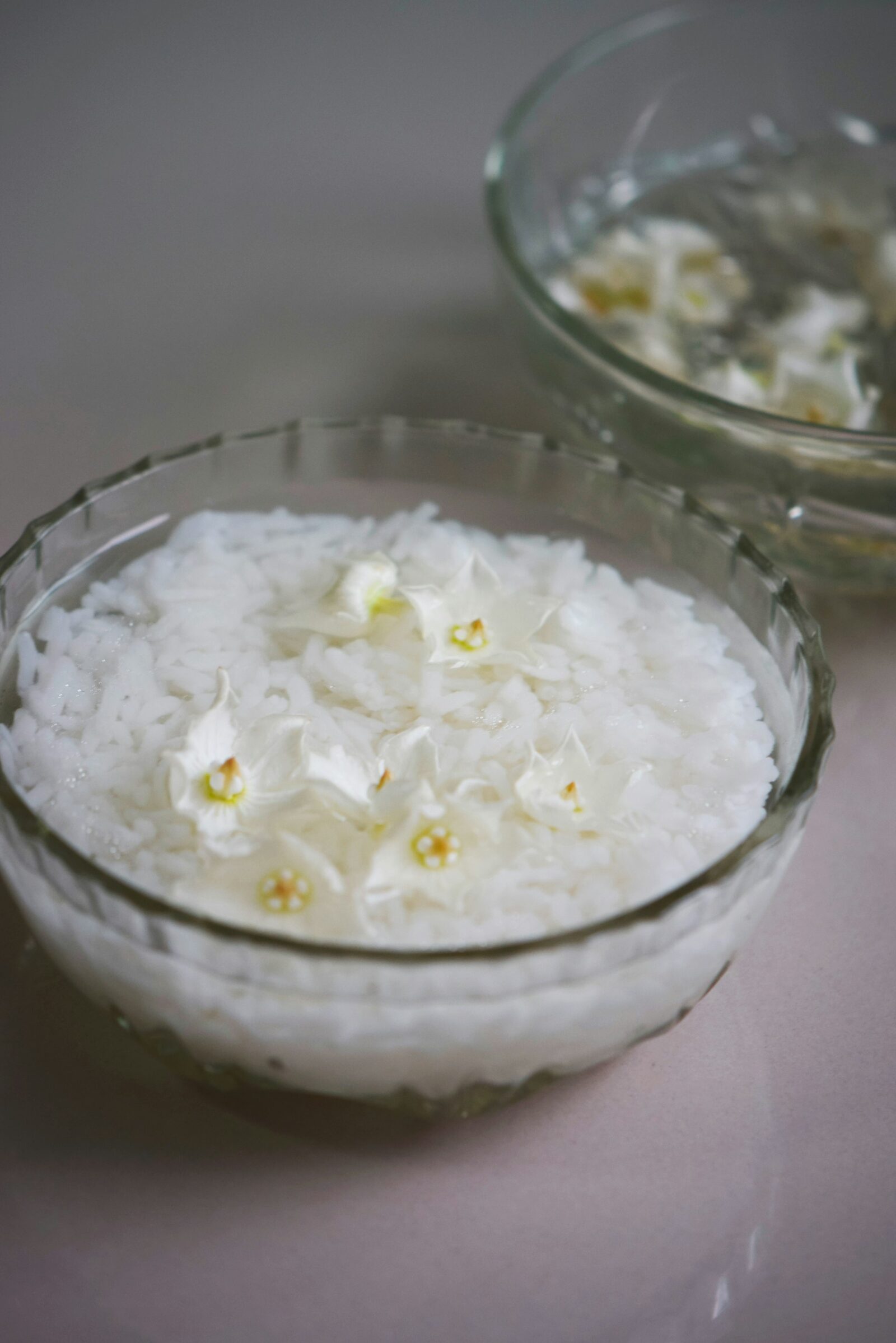
The beginner-friendly, no-cook rice water preparation. Ready in 35 minutes. The simplest method to keep clean, and the one to use for a patch test or for ice cubes.
Ingredients
- ½ cup plain white rice any variety; no study shows one is better for skin
- 2 cups cool water plus extra for the first rinse, which you pour away
Equipment
- Fine-mesh strainer
- Clean glass bowl
- Clean glass jar with airtight lid
Why this method
It’s the least that can go wrong. Nothing is heated, so nothing has to be cooled, and it’s done in the time it takes to tidy the kitchen. The liquid is thin and lightly cloudy: mostly water, with starch rinsed from the surface of the grains.
It’s also the nearest home equivalent to what little research exists. The one study of rice water on skin used a gel that was 96% rice water and found it well tolerated by 12 volunteers over 28 days [Marto et al. 2018]. That was a laboratory formulation, so treat it as mild encouragement.
Step-by-step
1. Rinse the rice and discard the rinse (30 seconds)
Put ½ cup of rice in the bowl, cover with water, swirl with clean fingers for a few seconds and pour the water away through the strainer.
This isn’t only about dust. Rinsing moves some of the arsenic rice carries into the water [Raab et al. 2009], so the first rinse is the water not to keep.
2. Combine rice and water (1 minute)
Return the rice to the bowl and add 2 cups of cool, fresh water. Stir once.
3. Soak at room temperature (30 minutes)
Leave it on the counter for 30 minutes. Swirl once or twice. The water turns from clear to lightly milky.
4. Strain (1 minute)
Pour through the strainer into the clean jar. Cook the rice as you normally would; nothing is wasted.
5. Refrigerate or freeze straight away
Lid on, into the fridge. Or pour into a clean ice-cube tray and freeze. Either way, within two hours of straining, which is the FDA’s rule for perishable food [FDA, storing food safely].
Tips for a better batch
- Wash your hands, the bowl, strainer and jar with hot soapy water before you start. This liquid has no preservative, and water is how cosmetics pick up “harmful microorganisms” [FDA, microbes in cosmetics].
- Make half the recipe (¼ cup rice, 1 cup water) if you’re only patch testing. The batch calculator does the sums for any amount.
- Write the date and time on the jar. The use-by helper will tell you when the borrowed 48-hour rule runs out [UK Food Standards Agency].
- Don’t add anything. Plain is easier to patch test and easier to keep.
Warnings
- Patch test first: a small spot on the inner arm, twice a day, “for seven to 10 days” [AAD, testing products], making fresh rice water as needed during the test.
- Keep it away from eyes, lips and broken skin.
- Don’t drink it, and don’t give it to children.
- If it smells sour or looks stringy, pour it away. If it smells fine but is past 48 hours in the fridge, pour it away anyway.
When to choose this method over others
Choose soaked for your first batch, for patch testing, and for ice cubes.
For a thicker, starchier liquid, see the boiled method. For the fermented version and why we’re cautious about it, see the fermented method.
Related
Storage
No one has tested a shelf life for homemade rice water. We borrow food rules: refrigerate or freeze within 2 hours of straining; use a refrigerated jar within 48 hours or freeze it; frozen cubes have no sourced use-by date, so label the bag with the day you made them.
Frequently asked questions
Do I have to use organic rice?
No. We found no study showing organic rice makes better or safer rice water for skin. What matters more is discarding the first rinse.
Can I skip the rinse step?
We wouldn't. A study of rinse washing found it removed around 10% of the arsenic from basmati rice, and whatever leaves the rice ends up in that water. Pouring the first rinse away is the easy way not to keep it.
How often should I use this on my face?
There is no studied schedule. After a patch test, two or three times a week is a cautious start. Stop if your skin feels dry, tight or irritated.
Sources for this page
Each line is an entry in the evidence register. The quoted passage was found in the source, word for word, on November 11, 2026.
- Raab et al. 2009 · laboratory · tested: Rinsing and cooking of basmati, long-grain, white and brown rice
“Rinse washing was effective at removing circa. 10% of the total and inorganic arsenic from basmati rice, but was less effective for other rice types.”
Raab A, Baskaran C, Feldmann J, Meharg AA. Cooking rice in a high water to rice ratio reduces inorganic arsenic content. J Environ Monit. 2009;11(1):41-4. - FDA, storing food safely · guidance · tested: U.S. regulator guidance for food
“Stick to the "two-hour rule" for leaving items needing refrigeration out at room temperature.”
U.S. Food and Drug Administration. Are You Storing Food Safely? - UK Food Standards Agency · guidance · tested: UK regulator guidance for food
“Eat leftovers within 48 hours or freeze them if you think this won't be possible.”
Food Standards Agency (UK). How to chill, freeze and defrost food safely. Published 18 December 2017. - AAD, testing products · guidance · tested: Dermatologist guidance for the public
“Apply the product to a test spot twice daily for seven to 10 days.”
American Academy of Dermatology. How to test skin care products. - Marto et al. 2018 · in vitro + human · 12 volunteers, 28 days · tested: Rice water, built into a hydrogel that was 96% rice water
“However, no scientific evidence supports their role in skincare products.”
Marto J, Neves Â, Gonçalves LM, Pinto P, Almeida C, Simões S. Rice Water: A Traditional Ingredient with Anti-Aging Efficacy. Cosmetics. 2018;5(2):26. - FDA, microbes in cosmetics · guidance · tested: U.S. regulator guidance
“Don't add water or saliva to cosmetic products, such as mascara. You may be adding harmful microorganisms.”
U.S. Food and Drug Administration. Microbiological Safety and Cosmetics.